
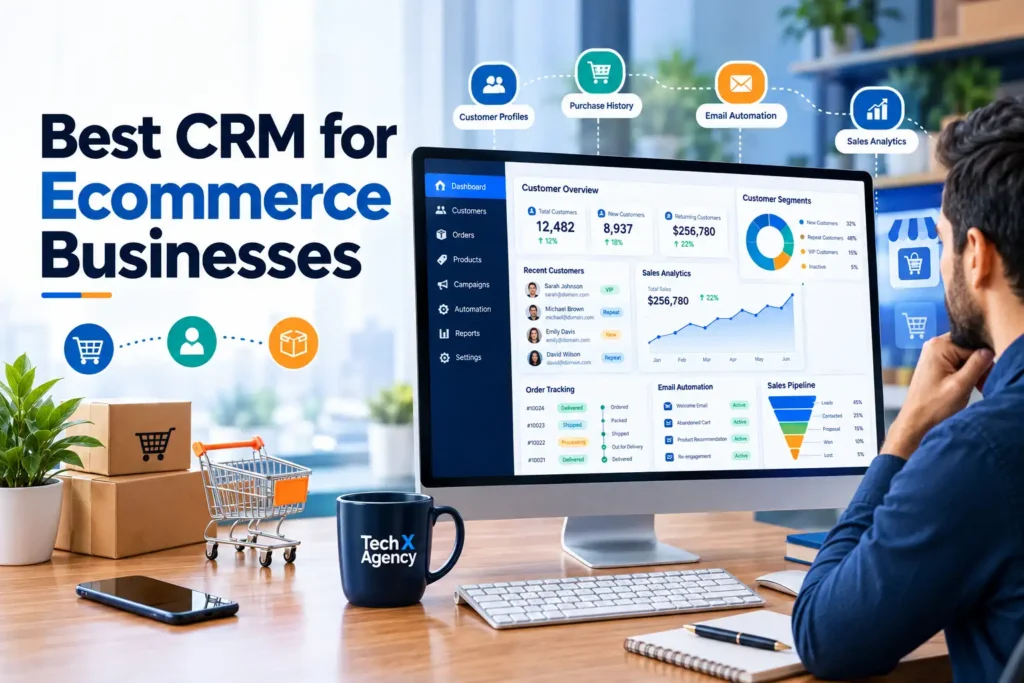
The key to finding the best CRM for ecommerce businesses isn’t popularity. It’s about locating a tool that suits your store, your funds, and your sales team. HubSpot, Zoho CRM, Salesforce, and Pipedrive serve different business needs. The best option depends on your store’s size, budget, and sales process. However, if none of these works for you, custom CRM software development may save you a lot of frustration.
The short answer is: HubSpot for newcomers, Zoho for small budgets, Salesforce for larger teams, and Pipedrive for stores focused on selling. Below, we compare each one, look at what they cost, and help you decide.
What Is Ecommerce CRM Software?
Ecommerce CRM software is a tool that stores customer information, orders, and conversations in a single place. This makes it easier for your team to sell and support customers without having to look through 10 tabs.
A simple CRM primarily manages leads and deals. An ecommerce customer management tool does that as well, but it also imports customers’ purchases, shopping carts and repeat orders from your store. As a result, you can learn who purchases, what is purchased and when they may return.
For instance, if customers order coffee beans every six weeks, your CRM can remind them of the order at week five.
Why Ecommerce Businesses Need CRM Software
Spreadsheets are an acceptable solution if you have 50 customers. However, when the orders start coming in, things get all out of control. There are a few simple ways a CRM fixes that, though:
- A single source of information for customers. So, you no longer have to search through inboxes and old files.
- Better retention. Also, identify repeat buyers and lure those who have stopped buying back in.
- Automated follow-ups. Thank-you emails and cart reminders, for example, are sent automatically.
- Clear sales tracking. Moreover, dashboards display sales and who is purchasing.
In the meantime, there’s an expectation that the shopping experience will be faster and more personalized. For a larger view of how the web as a selling environment functions, IBM has a good overview of ecommerce.
Best CRM Software for Ecommerce Businesses: The All-In-One Solution for Online Retailers
The following tools are for different types of stores. But features and prices vary with time, so do research on the vendor’s website before committing. In the end, the best CRM for ecommerce is the one that is aligned with your platform and your team’s workflow.
HubSpot CRM for Ecommerce
HubSpot is simple to learn and offers a free plan. It also features email and automation options. For this reason, it’s ideal for small stores looking to start light. However, paid levels could become costly as your contact list increases.
For ecommerce, HubSpot can connect with platforms like Shopify and WooCommerce, so customer and order data can sit next to your contacts. Still, the data that syncs depends on the integration you choose, so check it before you commit. Also, some of the more advanced features are only available on higher paid tiers.
Salesforce for Growing Ecommerce Companies
Salesforce is powerful and very flexible. Therefore, it is often selected by large teams with sales processes that are more complex. However, setup requires time and you will likely need someone who is knowledgeable to set it up correctly.
For ecommerce, Salesforce offers its own commerce products, and it also connects with many platforms through apps and connectors. As a result, it can handle detailed order and customer data. However, this usually needs a developer or consultant, and the integration work adds to the project.
Zoho CRM for Small and Medium-Sized Online Stores
Zoho offers a range of features at a reasonable price. It also integrates with other Zoho apps like inventory and accounting. So, if you’re looking for the best CRM for ecommerce at a cost-effective price without having to manage multiple vendors, it’s a great choice.
For ecommerce, Zoho works with platforms like Shopify and WooCommerce through extensions, and it pairs well with Zoho Inventory and Zoho Books. Still, third-party extensions may not sync every field, so test them with real orders first.
Pipedrive for Ecommerce Sales Management
Pipedrive is built around the sales pipeline. In addition, it’s easy to follow each deal with its visual boards, particularly when you are in a wholesale or B2B selling model. On the other hand, it is less equipped with marketing features out-of-the-box.
For ecommerce, Pipedrive usually relies on marketplace apps or third-party connectors to bring in store data. Therefore, order sync and purchase history may be more limited than in other tools, so check what your connector actually covers.
Shopify-Compatible CRM Solutions
Own a Shopify or WooCommerce store? Then, find a CRM that has a native integration or a trusted connector. In fact, many of them sync orders and customer profiles automatically. However, a CRM is not the same as an order management system, so find out exactly what will be synced.
Here is a quick comparison of the best CRM for ecommerce options:
| CRM | Best suited for | Stand out strength | Pricing model |
|---|---|---|---|
| HubSpot | Startups, small stores | Free plan, marketing tools | Free + paid tiers (pricing) |
| Salesforce | Large, complex teams | Deep customization | Per user, paid (pricing) |
| Zoho CRM | SMBs on a budget | Value and app ecosystem | Paid tiers, per user (pricing) |
| Pipedrive | Sales-led teams | Pipeline tracking | Per user, paid (pricing) |
Key Features to Look for in the Best CRM for Ecommerce
Not all stores have to have all the features. However, these are the seven most important:
- The customer profile combined with customer purchase history.
- Lead management and sales pipeline for keeping an eye on each and every sale.
- Email marketing and auto-replies.
- Customer segmentation for personalized offers.
- Ecommerce platform integrations. Here, too, your stock levels are important, so check out our article on how to select inventory management software.
- Sales reports and analytics. To gain deeper insight, use Google Analytics 4 ecommerce tracking with your CRM.
- Data security and access controls to protect customer information.
What Is the Price of Ecommerce CRM Software?
There is a wide range of prices, so a single figure would deceive you. Therefore, consider the total cost instead:
- Free plans include basic contact management and restrict users and automation.
- Paid plans typically cost on a per-user, monthly basis.
- Setup costs involve data migration, integration and employee training.
- Custom development is a project cost plus maintenance in future.
Additionally, if you sign up for a low-cost plan and you add extras, you may end up paying a lot more for the same service. So check out the current vendor prices, and match them up to your store’s needs.
What Is the Difference Between Ready-Made CRM and Custom CRM Software for Ecommerce?
Both paths work. However, the answer to this question will depend on the uniqueness of your business.
| Factor | Ready-made CRM | Custom CRM |
|---|---|---|
| Initial investment | Usually lower | Usually higher |
| Ongoing costs | Subscription and optional services | Maintenance, hosting and support, as applicable |
| Setup | You do not need to develop this application, but it can take a bit longer to set up | Built around your business |
| Features | Based on plans available | Built around business needs |
| Flexibility | Limited by the platform’s customization options | Fully flexible |
| Integrations | Depends on connectors available | Can be developed for specific systems |
| Best for | Businesses whose needs match existing features | Businesses with unique workflows |
When Is It the Right Time to Get Custom CRM Software for Your Ecommerce Business?
Most stores can use ready-made tools. However, a custom CRM system for your organization begins to sound like a great value to you when:
- The current CRM you have doesn’t have the capabilities you need.
- You have particular order and customer workflows which no strategy can mimic.
- You want to integrate inventory, accounting or other software you already use.
- Custom sales reports and dashboards are required.
Your business is growing, and you need more advanced workflows, reporting, and integrations. Besides, if you have a larger team, read on to learn about our custom software development for enterprises approach.
TechXAgency Can Assist You in Creating the Ideal Ecommerce CRM
Our CRM software development services are tailored to your team’s workflow. That is, we don’t impose the mold on you. Here’s what we do:
- Develop tailor-made CRM solutions for online businesses.
- Integrate and tailor off-the-shelf CRM applications like Salesforce, Zoho, or HubSpot.
- Manage ecommerce sites, inventory and accounting systems for CRM integration.
- Create customer dashboards and reports that your team will really use.
- Plan for growth and ensure the software can support increasing sales.
Ready to talk? Contact TechXAgency today to explore your CRM needs and get a project quote.
How to Choose the Best CRM for Ecommerce Businesses
Choosing the best CRM for ecommerce businesses is quite simple. Here are the steps to help shortlist your choices:
- Determine your company needs. First, list down the features you cannot do without.
- Next, test integrations to your ecommerce solution.
- Don’t just compare the monthly charge, but features and total expenses.
- Evaluate automation and reporting. Then test them using real data.
- Also, evaluate data security and scalability.
- Finally, choose between ready-made and custom. When you continue to hit the limits, it’s time to consider custom.
Conclusion
Choosing the best CRM for ecommerce comes down to your platform, your team, and the way you sell. HubSpot and Zoho CRM are good starting points for small stores, Salesforce suits larger teams with complex processes, and Pipedrive works well for sales-led businesses. However, if your workflows don’t fit any ready-made tool, a custom CRM may be worth considering. Finally, test your shortlist with real orders and customer data before you decide.
Frequently Asked Questions
Which is the best CRM for ecommerce?
There is no clear winner. The best CRM for ecommerce is the one that aligns with your platform, team size, and workflow.
So which is the best CRM for a small ecommerce business?
HubSpot and Zoho are some of the preferred choices. Moreover, they are both easy to learn and expandable.
Do you have any free CRM software for ecommerce?
Yes. There are a number of free plans provided by several different vendors, such as HubSpot. Typically, they restrict either users, automation, or reporting, so you should read the fine print first.
What is the cost of ecommerce CRM software?
It depends on users, features and integrations. Paid plans usually cost per user per month, while custom development is a project cost plus ongoing maintenance.
Is it possible to tailor a CRM to an online shop?
Yes. There are options to customize an existing CRM using integration and workflows, and to create an entirely new CRM system. In addition, TechXAgency can assist you with both.